Category Archives: Heat Sinks

Isothermal Plate Provides Precise, Controllable Heat Source to Simulate Hot IC’s for Heat Sink Development or Test and Measurement

Advanced Thermal Solutions, Inc. (ATS) CIP-1000 is a controllable isothermal plate system which produces surface temperatures from 10 to 170°C. The temperature can be controlled with an accuracy of +/- 0.1°C. The CIP-1000 heat source system features a 75 mm diameter isothermal copper plate whose constant temperature can be raised or lowered both automatically and manually. A three wire RTD sensor and integral PID controller ensure specific, uniform temperature across the entire plate. Temperature settings can be programmed for automated ramping, including hold times for each step. Manual temperature management is also supported.

Applications include:

  • Simulating a hot semiconductor for thermal development of heat sinks
  • Temperature control for bio-technology applications
  • Quick spot heating of materials needed in electronics hardware lab prototyping work

You can learn more by visiting the ATS CIP-1000 Information Page

What Heat Sink Attach Method to choose? Alpha’s “Quick Set” Heat Sinks & ATS superGRIP are two ways to try

For those of us in the heat sink, heat sink attach and thermal design space heat sink attach is a big bugaboo.  There are many options to choose from for sure and each has it’s own pluses and minuses.   The key is to choose the right attachment method given the thermal requirements, application and cost.  Many times engineers will just default to tape and when in doubt will choose epoxy.   At ATS we’ve seen the use of thermal epoxy so much it makes us weep!   Epoxy seems like the answer to make sure a heat sink stays on during shock and vibe testing.  The use of the epoxy is subject to many variables.  There are other options, two of which just came onto the market.

Alpha Novatek has just released it’s Quick Set family of Heat Sinks.  Here’s a description from their press release

Electronic components have become faster and more compact, generating more heat and increasing thermal densities. This has led to the use of heat sinks of increased size and mass. One of the biggest challenges for thermal/mechanical engineers is mechanically mounting larger heat sinks while minimizing the amount board real estate used by the attachment mechanism. Generating sufficient attachment force is also critical with regards to mechanical security and proper performance of thermal interface materials.

Alpha’s new Quick Set series heat sinks have been designed to address both issues, providing secure and reliable attachment while requiring the absolute minimum of board real estate.

In a nutshell, Quick Set requires a small mounting pins be placed onto a PCB. Mounting pins only require 1.8mm[.071″] diameter holes in the PCB.  Then a heat sink can be clipped on creating a secure attachment that uses minimum space.   It also appears it can handle oversize heat sinks too, a real boon with large footprint semiconductors.  More information and photos are on the official announcement on Alpha Novatech’s web site at this link here.

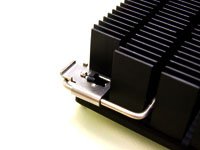
For ATS’s part, we’ve approached this same problem of heat sink attachment by way of clip technology.   Our latest is superGRIP, an attach technology which puts a clip around the semiconductor and allows spring to hold the heat sink down.  Our studies and those of our major customers indicate superGRIP does not put strain on a BGA.   superGRIP’s differentiator over Alpha’s Quick Set is that superGRIP does not require any holes in an electronics board PCB.   It also provides the precise pressure to allow phase change interface material to be used to it’s best advantage with a heat sink.  You can learn more about superGRIP by visiting ATS’s Slideshare Channel or by visiting ATS superGRIP Web Site.

How Thermal Engineers taught the Thermal Marketer a thing or two about heat pipes, heat sinks & thermal design

I couldn’t pass up a chance to pick the brains of two of Advanced Thermal Solutions engineers when Intel announced it’s Intel DBX-B Advanced Thermal Solution for the Core i7-980X EE processor. First, it was our name afterall, Advanced Thermal Solutions, Inc.  Second, from my work in the past with Intel on the Itanium program I thought, “what are they doing, this thing is near the size of my lawn mower engine”. But Joe Mennucci, Direct of Engineering, and Dr. Ning Lei, Senior Thermal Physics Researcher, schooled me in the hows and why’s.

John: So tell me, Ning and Joe, this Intel DBX-B, it’s really useless isn’t it? I mean look at this thing!
Joe: (Looks at Ning and smiles. Then looks at John, eyes looking over the rim of his glasses like he’s looking at one of his first year mechanical engineering students at RPI)
Ning: Well, the Intel DBX-B is not useless. In fact, it might be one of the most efficient heat sink designs of its type. Both cost-effective and it pushes the limits of thermal physics.

Joe: Here’s how these kind of heast sinks work. Heat sinks like The Intel DBX-B or the Scythe Yasya Heatsink use an embedded heat pipe approach. Basically, heat pipes are embedded into the aluminum fins of the heat sink, as the CPU heats up, the liquid in the heat pipe heats up, turns to steam, rises and transfers its heat to the aluminum fins. Once it cools, it condenses and seeps back down the pipe. It’s a very efficient cooling approach.
Ning: That’s right Joe. Also, the fans on these kinds of heats sinks are often custom made for the heat sink or the heat sink is designed to it fits to the fans. Convection cooling is then used to further cool the heat sink.

John: These must cost a mint though, look how much metal is there!
Ning: (Rolls eyes )not really, about $40 to $70 per heat sink system.
Joe: When you think of it, it’s a good deal.

Ning: Here at Advanced Thermal Solutions in our labs, we have developed a similar heat sink to the The Intel DBX-B or the Scythe Yasya Heatsink. We used heat pipes embedded into copper skived fins to create a similiar and as efficient approach. The key design point though is heat pipes of some number and the vapor release of heat energy through the fins.
Joe: So, John, do you still think these big heat sinks are useless?
John: (Light dawning on marble head ) Yes I finally do see how cool these big heat sinks can be!

Higher Speed Processors Force Other System IC’s to Speed Up Increasing Overall Thermal Problems: Here’s what to do

The increasing speed of expensive processors is forcing less expensive “associated board” or “dependant” devices to keep up. Consequently, thermal management and EMI are becoming issues for traditional lower frequency or power devices, such as ASIC, memory, power resistors, controller chips, LEDs, and other traditionally lower power devices that comprise 70 to 80 per cent of all devices. For many engineers, this is not only an expansive challenge but also a first-time issue with devices that once ran lower speeds and consumed less than 0.25 W but evolved to 0.50-20 W.

So what to do? One way to address this challenge is by way of the right thermal interface material. 3M’s Jeff McCutcheon has a great article on this topic at EP&T. You can have a read at EP&T by clicking to his article, “Higher frequencies leading to rising power and EMI in traditionally low power electronic devices“.

ATS’s did a few articles on this topic our readers will find helpful here on our blog.

ATS announces QoolPCB – Fixed Price for All Heat Sinks on any PCB

Its a challenging time economically for many firms and ATS is ready to help!  Our new QoolPCB program is a fixed cost board cooling program program which offers users a single, fixed price for the complete set of heat sinks required to cool any PCB.

The QoolPCB program includes all design engineering, hardware, testing, procurement and delivery costs for the heat sinks, thermal interface materials, attachment devices and all other parts required for the effective thermal management of a board’s components. The fixed cost applies whether the solutions are for off-the-shelf heat sinks, custom designed, or a combination of both.

To participate, PCB developers simply provide 3D CAD models of their board layout, along with the technical specifications, including power dissipation of all board components. ATS performs a full thermal analysis of the PCB and develops a comprehensive cooling solution for each component on the board. For more information, visit the ATS web sites program here: QoolPCB