Category Archives: Air Cooling

Making the Change

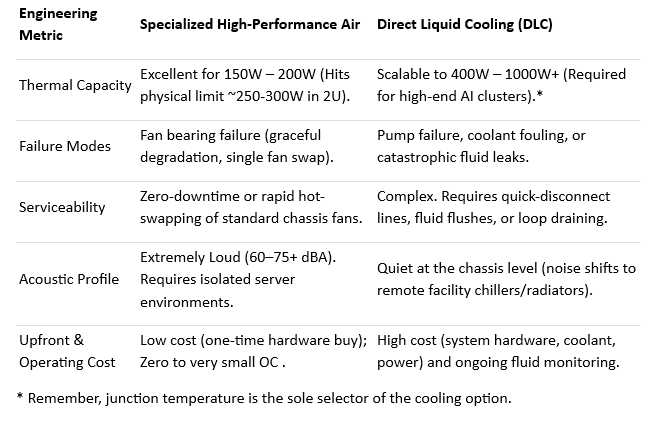
Air cooling was once the dominant method for cooling processors on a PCB, employing heat sinks, fans, and blowers. These solutions are still popular, but faster-running, higher-powered devices, like most GPUs used for AI can’t be sufficiently cooled with air. Liquid cooling is needed. [1,7]

There isn’t a universal application point where engineers must switch from air cooling to liquid cooling. The decision mainly depends on allowable temperature and heat flux. Other considerations include higher costs and power needs, added hardware, space and weight, and required more monitoring. [1,3]

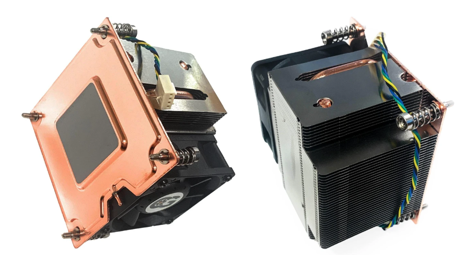
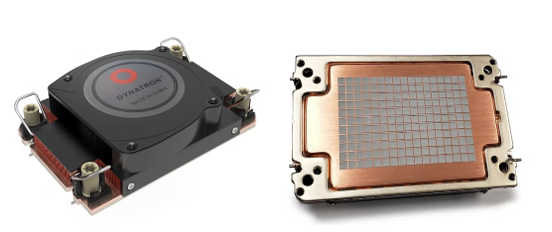
Fig 1 – Air Cooling Heat Sink vs. Liquid Cooling. [9,10]

In practice, once devices reach several hundred watts in a compact package, or when the required thermal resistance approaches 0.1°C/W or lower, liquid cooling often becomes the preferred solution.

Low Thermal Resistance

Engineers usually don’t switch to liquid cooling simply because a chip reaches a particular wattage. They switch when the required junction-to-ambient thermal resistance falls below what can be achieved economically and reliably with available airflow and heat sink models. [2,3,5]

Fig 2 – Typical Chip Temperature Location [11]

Consider an equation and example:

Tj = Tα+ P x RαJA                              [2]

Where:

Tj = junction temperature

Tα = ambient temperature

P = power dissipation

RαJA = thermal resistance from junction to ambient

If keeping the chip within its temperature limits requires an unrealistically low thermal resistance, air cooling may not be practical.

Example:

Ambient = 40°C

Maximum junction temp = 90°C

Chip power = 500 W

The allowable thermal resistance is:

RαJA = 90 – 40 /500 = 0.1°C/W

Achieving 0.1°C/W with air is extremely difficult. Liquid cooling is the practical solution. [2,3]

High Heat Flux

Heat flux (power per unit area) is often more important than total power. [3]

For example:

  • A 100 W device spread onto a large heat sink may be easy to air-cool
  • A 100 W device concentrated in a 1 cm² die can be much harder

Modern high-performance processors, GPUs, laser diodes, RF power amplifiers, and power electronics often reach heat fluxes that make air cooling difficult.

Fig 3 – Heat Flux Measures the Amount of Heat Energy Transferred from a Warmer Side to a Cooler Side. [12]

Typical industry guidance suggests:

  • Air cooling: comfortable below ~10–20 W/cm² [1,6]
  • Advanced air cooling: can sometimes handle 50–100 W/cm² with aggressive airflow [1,6]
  • Liquid cooling: often becomes attractive above ~100 W/cm² [1,6,7]

In basic terms:

  • Air cooling is usually limited by how much heat you can transfer from the heat sink to the air.
  • Liquid cooling is usually limited by how much heat you can get from the chip into the coolant.

Where Air Cooling Works Well

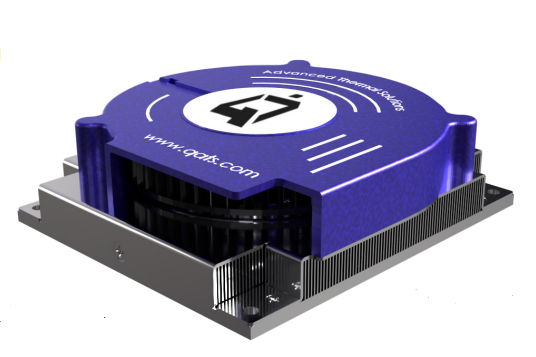
Fig 4 – Heat Sinks from Advanced Thermal Solutions, Inc. [9]

  • Total heat dissipation is relatively modest, up to a few hundred watts
  • There is enough surface area for heat sinks
  • There is sufficient airflow through the enclosure
  • Higher fan noise is acceptable  [1,3]

Air cooling is used in many consumer electronics products and networking devices.

Coolants Remove More Heat

Since water-based coolants have much higher heat capacity and thermal conductivity than air, they can transport large amounts of heat away with relatively small temperature rises. [3,9]

For example:

  • Air’s specific heat capacity is about 1 kJ/kg·K 
  • Water’s is about 4.2 kJ/kg·K   

And water is about 830 times denser than air, so a small coolant flow can carry away an enormous amount of heat compared with an equivalent volume flow of air. [9]

Fig 5 – Tubing and Ports on a Liquid Cooling System [9]

That’s why modern AI accelerators, high-power motor drives, and high-density data-center servers are increasingly moving toward liquid cooling: not because air cooling is impossible, but because the required heat removal density becomes impractical with fans and heat sinks alone. [1,7,8]

The Benefits of Faster Flow Rates

Air cooling performance increases when the rate of airflow increases. Thus, many heat sinks are supported with fans and blowers to enhance heat transfer into the passing air. [3]

Liquid cooling, similarly, is enhanced with higher flow rates. A common expectation is that a coolant that stays longer at the heat source (chip) will absorb more heat. But, at slower flow rates, the coolant heats up as it moves through a cold plate and downstream in the cooling loop. As a result, the returning coolant has less of a temperature difference from the chip, and heat transfer becomes less effective. [3,4]

With a faster flow of liquid coolant, the fluid temperature stays more uniform and keeps a steady, higher temperature difference from the chip. This makes heat extraction more efficient and improves the lowering of chip temperatures. [3,4]

Flow rates can be optimized per application. There are diminishing returns on performance as flow rates increase, as well as added costs. Your liquid cooling system provider should provide performance data and recommendations for proper flow rates. [3,4]

In-Between Air and Liquid Cooling

There are options that fall between air and liquid cooling methods. Engineers should look through these choices before designing in a liquid system. They could provide simpler, lower-cost, but reliably effective cooling       

The expanded options include:

  1. Better PCB thermal design (thermal vias, thicker copper planes)
  2. Larger heat sinks
  3. Forced-air cooling with optimized airflow paths
  4. Heat pipes or vapor chambers to spread heat
  5. Remote heat exchangers connected by heat pipes
  6. Liquid cold plates       [3,4]

Fig 6 – Heat Pipes May Meet Cooling Needs in Place of Air or Liquid Cooling [9]

Not a Tradeoff

Traditional air cooling is inadequate for many of today’s thermal management needs. Other methods, including enhanced air cooling  systems, may offer solutions. But for many applications, including fast-growing AI units and data centers, liquid cooling is essential. In this case, there is no tradeoff because its use is the only option. [1,6,7]

Consider This

Here are some analogies for comparing air to liquid (water) cooling:

Air is a ghost. Because air is so light and empty, a single cubic meter of it can only grab a tiny handful of heat before it gets too hot and gives up.

Water is a sponge. Because water is about 830 times denser and packed tight with mass, that same one cubic meter acts like a massive thermal sponge. It can swallow up a staggering amount of heat before its temperature rises even a single degree.

To cool a hot system, you either have to blow a hurricane of lightweight air past it, or gently glide a tiny, heavy stream of water over it.

References

  1. ASHRAE. Thermal Guidelines for Data Processing Environments, latest edition.
  2. JEDEC Solid State Technology Association. JESD51 Series: Methodology for the Thermal Measurement of Component Packages.
  3. Frank P. Incropera, David P. DeWitt, Theodore L. Bergman, and Adrienne S. Lavine. Fundamentals of Heat and Mass Transfer, Wiley.
  4. David A. Reay, Ryan McGlen, and Peter Kew. Heat Pipes: Theory, Design and Applications.
  5. Texas Instruments. Thermal Design by Insight, Not Hindsight (Application Report).
  6. Open Compute Project Foundation. Advanced Cooling Solutions documentation.
  7. NVIDIA. Data Center Liquid Cooling technical papers and deployment guides.
  8. National Institute of Standards and Technology (NIST). Thermophysical Properties of Fluids Database.
  9. Advanced Thermal Solutions, Inc., https://www.qats.com
  10. Chatsworth Products, https://www.chatsworth.com/en-us/resources/blogs/2026/5-misunderstood-facts-about-direct-to-chip-liquid-cooling/
  11. Advanced Thermal Solutions, Inc, https://www.qats.com/
  12. EngineerExcel, https://engineerexcel.com/flow-of-heat/

Cooling Embedded AI Electronics

Embedded AI enables dedicated functions within larger systems. These AI chips power countless devices—robotic arms, smart thermostats, security cameras, medical instruments, drones, and vehicles—enhancing functionality and decision-making at the edge.

ChatGPT is one of the most visited websites in the world. Along with Gemini, Perplexity AI, Grok, and many others, online AI tools are increasingly popular and specialized. This is leading to more power-hungry AI data centers, where hundreds of thousands of GPU chips run at upwards of 1,000 watts each. [1]

But millions of lower power AI chips are running quietly in edge applications all around us.

In smart homes, embedded AI powers thermostats, voice/image recognition, and security. In factories, it drives automated quality control, predictive maintenance, and robotic assembly.

Figure 1 – Embedded AI Systems in Industry Provide Fast, Local Processing to Enhance Production and Safety. [2]

Using local AI inference, these systems make independent decisions, predict outcomes, and automate operations in real time. Connected via the Internet of Things (IoT), they share data and improve interoperability, making homes and factories smarter and more efficient.

AI Technologies in Embedded Systems

  • AI vs. ML: Artificial Intelligence (AI) includes deep learning that uses artificial neural networks to process unstructured data. Machine learning (ML), a subset of AI, focuses on training algorithms to learn from data and adapt over time.
  • Discriminative AI: Embedded systems typically use discriminative AI—optimized for data analysis and evaluation—requiring lower compute power than generative models.

Embedded AI Chips and Cooling Needs

AI processors and modules in embedded applications are not the high-powered versions in data centers. For those, liquid cooling with constant monitoring is essential.

Figure 2 – Intel FPGAs Support Real-Time Deep Learning Inference for Embedded Systems and Data Centers. [4, 5]

Embedded AI processors often come in compact system-on-module (SOM) formats that include CPUs, memory, and specialized chips like GPUs or DSPs. These modules prioritize space efficiency and typically rely on air cooling—either passive or fan-assisted—rather than the liquid cooling found in high-wattage data centers.

Following are some popular AI processors and approved heat sinks.

AMD Kria™ SOMs

The AMD Kria K24 SOM runs on as little as 2.5 watts and typically uses a passive (fan-less) heat sink. Its low power and compact size allow it to be installed close to the processes it manages, such as intelligent motor control. The more capable Kria K26 SOM supports higher-end tasks like machine vision and robotic planning and may require active cooling. [6]

Figure 3 –The AMD Kria K24 and K26 SOMs Can Be Used for Sophisticated Robotic Applications. The K24 Provides Intelligent Motor Control. The K26 Manages Complex Machine Vision. [6]

In the above robotics application, different heat sinks are available to cool the K24 and K26 SOMs. These come in varieties for providing optimum levels of air cooling, as well as for fitting available spaces. The K24 SOM can be cooled with a passive (fan-less) sink. Depending on its application, the K26 SOM may need an active heat sink. Examples of heat sinks for cooling the K26 SOM are below. [7]

Figure 4 – Fan-assisted Heat Sinks, Like the Above ATS Model May be Needed for Cooling AMD Kria K26 System-on-Modules. In Some Applications, Passive (fan-less) Heat Sinks are Sufficient.

Figure 5 – Three Passive Heat Sinks Developed to Cool AMD Kria K24 SOMs. The Taller Finned Versions Provide More Cooling Performance but Need More Headroom and are Heavier. [8]

NVIDIA Jetson Modules

Widely used NVIDIA Jetson modules power a wide range of AI in embedded systems. These compact, powerful modules enable AI solutions in manufacturing, logistics, and healthcare. They leverage NVIDIA’s GPU technology for accelerated AI computations.

In the Jetson module family, Orin systems are specifically engineered to provide high-speed support for a wide range of sensors, enabling seamless integration with various edge AI applications.

One of these, the Jetson AGX Orin series, uses just 15 to 75 watts of power depending on the specific module, workload, and external factors such as local temperatures. They’re designed for passive cooling to manage heat in applications with prolonged operating temperatures, where fans could be affected by dust and debris. [9]

Figure 6 – Top: NVIDIA’s Jetson AGX Orin Module Features an AI Accelerator Graphic Chip and an  Ampere GPU Architecture Chip in One Package. It Can be Passively Cooled with a Specially-Designed, NVIDIA-Approved ATS Heat Sink. [9,10]

Bottom: The Many Uses of Orin Modules Include Embedding in Zipline Delivery Drones [11]

The Orin, another Jetson module, is a small, powerful computer for embedded AI applications connected to the IoT. Its capabilities include deep learning, computer vision, graphics, and multimedia.

Figure 7 – Top: An NVIDIA Jetson Orin Nano Module and a Specially-Designed ATS Active Heat Sink. [12, 10] Bottom: Multiple Security Cameras and Sensors Feed Visual Data to an Orin Nano Module Whose AI Detects Unusual Activities. [13]

One application for Orin Nano modules is in security surveillance systems. Cameras and sensors are placed in strategic locations. The Orin Nano module processes their visual data, detecting unusual activities and triggering alerts when identified by the AI.

When Air Cooling Isn’t Enough

One exception to air cooling for embedded processors is in some smart phones. Tasked to perform ever more functions, including AI, their increasingly powerful chips require higher performance cooling.

For example, Qualcomm Snapdragon 8-series chips, used in phones like the OnePlus 13, generate significant heat under heavy loads. Vapor chambers help dissipate that heat across a broader surface for effective cooling without active fans.

Figure 8 – Top: The Top-Rated OnePlus 13 Phone Features a Qualcomm Snapdragon 8 Elite Chip. Botton: A Teardown Video Reveals the Vapor Chamber for Cooling the Snapdragon Chip. [14,15]

Embedded AI Efficiency

Embedded AI continues to gain ground due to its compact design, low latency, and localized processing. Its benefits include:

  • Reduced network load by transmitting processed insights rather than raw data
  • Lower system cost vs. cloud-based AI
  • Lower power consumption, enabling simpler and cheaper cooling solutions

With AI now embedded across sectors—from smart homes to drones to industrial robotics—thermal management solutions are evolving alongside to ensure performance and longevity.

References

  1. MIT Technology Review, https://www.technologyreview.com/2025/05/20/1116327/ai-energy-usage-climate-footprint-big-tech/
  2. GIGAIPC, https://www.gigaipc.com/en/solution-detail/Machine-Vision/
  3. Embedded, https://www.embedded.com/ai-efficiency-will-depend-on-model-size/
  4. Intel, https://www.intel.com/content/www/us/en/software/programmable/fpga-ai-suite/overview.html
  5. Mirabilis Design, https://www.mirabilisdesign.com/intel-fpga-neural-processor-ai/
  6. Electronic Design, https://www.electronicdesign.com/technologies/industrial/boards/video/21273991/a-look-inside-amds-kria-k24-system-on-module
  7. AMD, https://www.technologyreview.com/2025/05/20/1116327/ai-energy-usage-climate-footprint-big-tech/
  8. Advanced Thermal Solutions, Inc., https://www.qats.com/Heat-Sinks/Device-Specific-AMD-Kria-K26
  9. NVIDIA, https://www.nvidia.com/en-us/autonomous-machines/embedded-systems/jetson-orin/
  10. Advanced Thermal Solutions, Inc., https://www.qats.com/Heat-Sinks/Device-Specific-NVIDIA
  11. Things Embedded, https://things-embedded.com/us/nvidia-jetson/orin/agx/
  12. NVIDIA, https://www.nvidia.com/en-us/autonomous-machines/embedded-systems/jetson-nano/product-development/
  13. Prox PC, https://www.proxpc.com/blogs/case-studies-real-world-applications-of-nvidia-jetson-orin-nano
  14. Tom’s Guide, https://www.tomsguide.com/phones/oneplus-phones/oneplus-13-is-official-and-one-of-the-first-snapdragon-8-elite-powered-phones
  15.  PBKreviews, https://www.youtube.com/watch?v=WqJq3-ngL2Q

CPU Coolers with TDP at 160W+ and Thermal Resistance of .012

ATS fanless, straight-fin heat sinks maximize system airflow for passive cooling of CPUs in a wide range of devices. These fanless, straight-fin heat sinks maximize system airflow to reliably cool high-performance processors at a lower cost than using heat sinks with fans. When attached with the available backing plate, these rugged heat sinks are usable on a wide variety of CPUs in industrial and commercial applications. Works with Intel, AMD, Nvidia CPUs, GPUs.

Available worldwide through our distribution network.

See the whole family here: ATS Fanless CPU Coolers.

Talk to one of our engineers on if our fanless High Performance Coolers are a good fit for your application, email us at: ats-hq@qats.com

2mm High Heat Sinks Perfect for Cooling Tight-Spaced, Passive Cooling Applications

blueICE ultra low-profile heat sinks come in 2 to 7mm heights and are ideal for tight-space, passive cooling applications such as:

– connected appliances

– IIOT (Industrial Internet of Things)

– autonomous farming equipment

– drones.

blueICE™ heat sinks are very lightweight, ranging from 4 to 30 grams. No mechanical hardware is needed to mount them to components. A double-sided, thermal conductive adhesive tape can be used to attach a blueICE heat sink securely.

Their spread fin design offers thermal resistance as low as 1.23° C/W in air velocity of 600 ft/min.

blueICE heat sinks are very lightweight, ranging from 4 to 30 grams. A double-sided, thermal conductive adhesive tape can be used to attach a blueICE heat sink securely. This no-hardware attachment method reduces weight and assembly time, while saving valuable board space. Available from ATS’s global distribution network. 

==> Cool your tight spaced projects! Blue Ice heat sink web page

==> Is BlueIce the right HS for your application? email our engineers and we’ll help you design a solution: ATS Engineering Team